
Issues Related to ADHD
ADHD ( attention deficit/hyperactivity disorder) is a neurodevelopmental disorder that affects approximately 6% of school-aged children and 2.5% of adults.
For many affected individuals, it persists well beyond childhood.
This neurotypical brain function is described as a triad.
The disorder combines symptoms in three clinical dimensions:
- Inattention: high distractibility, difficulty concentrating,
- Impulsivity: difficulty waiting, impatience,
- Hyperactivity: constant restlessness, need to move
and can impact the schooling of children and adolescents, the professional lives of adults, as well as their social and family lives.
It is important to remember that ADHD is a neurological disorder involving brain dysfunction. This detail is crucial because it allows those around the individual (family, school, etc.) to understand that it’s neither defiance nor a lack of effort; the person isn’t doing it intentionally, and their behavior is involuntary.
This disorder, due to alterations in brain neural networks, as neuroscience has demonstrated, contributes to a distorted perception of oneself in the environment. This means there are structural reasons, direct consequences of ADHD, for having particularly impaired and fragile self-confidence.
The Benefits of Sophrology
Sophrology has a valuable role to play as a complement to the multidisciplinary care of individuals with ADHD.
Indeed, sophrology offers concrete and effective tools to help people with ADHD feel better in their daily lives: from calming mental agitation and the incessant flow of thoughts to improving concentration and achieving more peaceful sleep.
Here’s how sophrology can help someone with ADHD:
We often work in conjunction with psychologists, psychomotor therapists, and even speech therapists.
- Refocus, concentrate, and be more attentive
- Build self-confidence
- Release accumulated tension
- Recognize and manage emotions
- Be more self-aware and control impulsivity
- Facilitate falling asleep and sleep more peacefully
- Manage anxiety, worries, and stress
Sophrology contributes to the well-being of people with ADHD by helping them improve their daily quality of life.
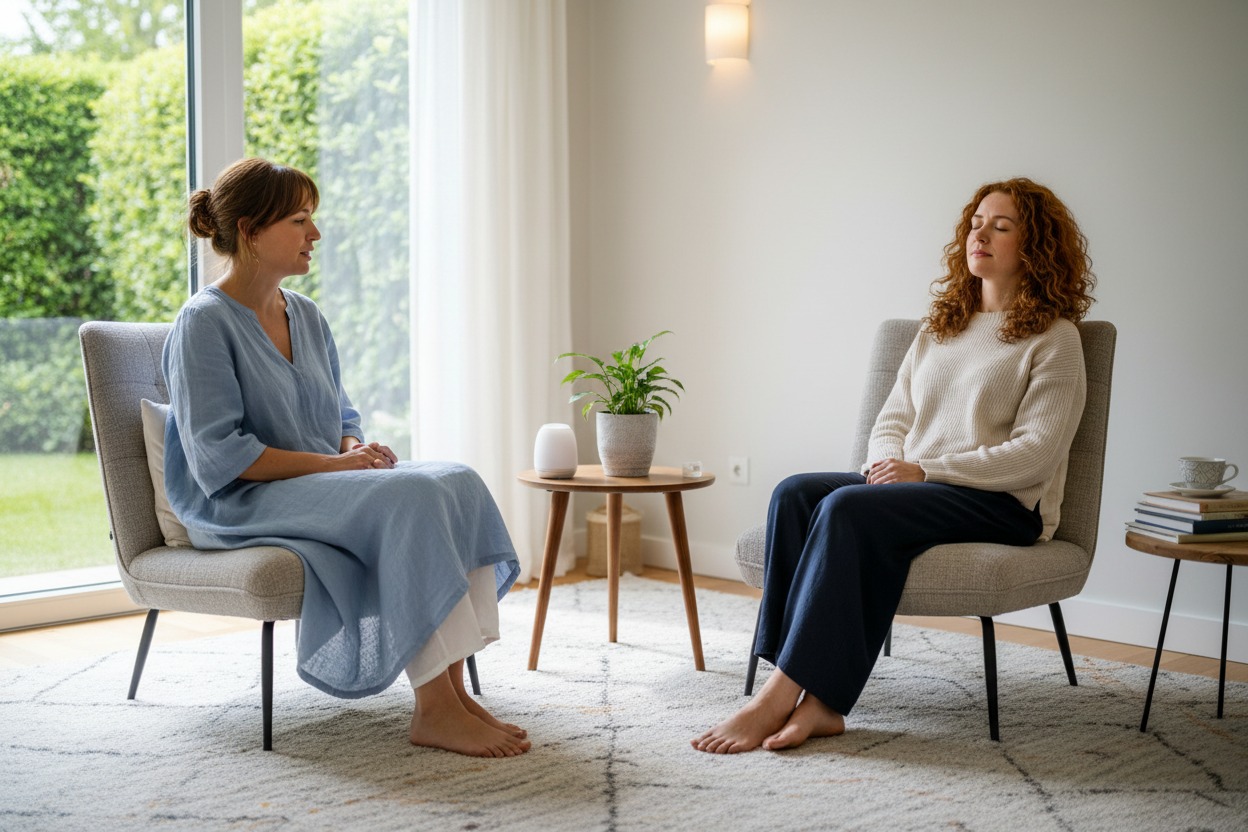
The Sophrology Session Process
The Initial Consultation
During this first meeting, which lasts between one and one and a quarter hours, we have a lengthy discussion that allows me to better understand the context and the difficulties encountered. It is also during this first appointment that we set the objectives to be achieved.
Subsequent Sessions
Each subsequent session consists of dynamic relaxation exercises, short breathing games, tools for managing emotions, and brief relaxation periods.
The sessions may be interspersed with breaks to allow the child to move around if they feel the need.
The exercises are playful and adapted to each child’s attention span.
Sessions can take place in the office or online.
Sessions are held approximately twice a month.
Over the course of the sessions, the child acquires a set of tools to use in their daily life. These tools allow him to better manage his difficulties independently. He will then be able to integrate and retain them throughout his life.
These tools are compiled in a binder that I provide, into which we insert breathing exercises, tips, and other relaxation techniques, according to our objectives.
The child is encouraged to implement these tools at home (and at school if needed) for greater effectiveness in daily life and to achieve his goals more quickly.

Breathing Exercise to Refocus and Focus
People with ADHD are bombarded with all sorts of external stimuli and have difficulty concentrating. The restlessness resulting from hyperactivity can also be difficult to manage.
In the morning or in the evening before meals, a short breathing exercise can be done to refocus and focus attention. This exercise can be added to your morning or evening to-do list, or even practiced before going to sleep.
Here is an exercise that will only take a few minutes to read and download to listen to at home:
THE BALLOON
I inhale, expanding my belly. I exhale, deflating my belly.
I can imagine a pretty balloon at my belly, inflating and deflating with my breathing.
I can visualize that my balloon has a color. I remain focused on the color of my balloon. I inhale, expanding my belly. I exhale, contracting my belly.
Then my balloon may change color. I always observe my balloon as it inflates and deflates.
By maintaining my attention on my breathing and on my balloon, I can calm my inner turmoil and thoughts, and refocus.